Hyundai i10 reliability, MPG and running costs
Figures updated
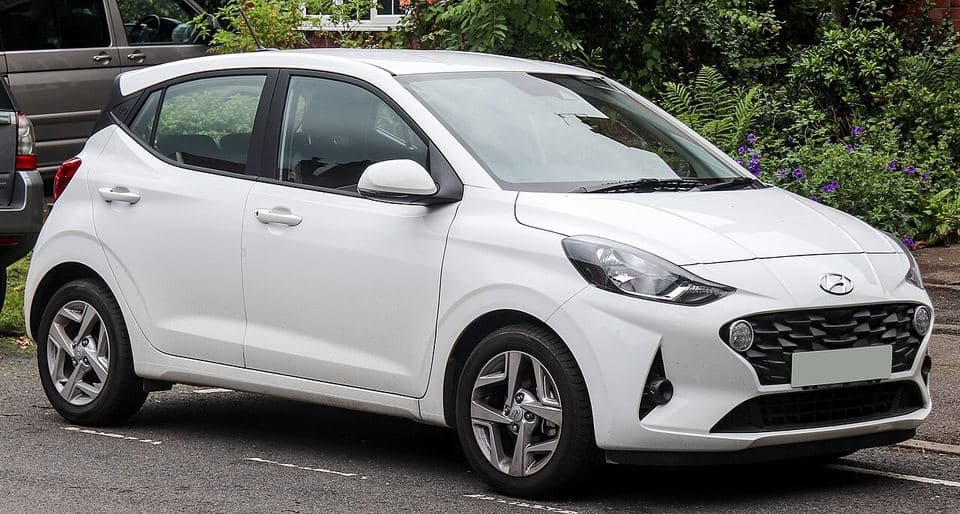
The Hyundai i10 is a city car; the latest version we cover is the Mk3 (2019–). In 2024 MOT tests it scored 86 for reliability (100 is average), ranking 349 of 442, and 27.5% failed first time against a UK average of 28.5%. Its most common MOT failure is wipers (3.6% of tests). Boot space is 252 litres (1,050 with the seats folded).
Hyundai i10 key specs (Mk3 (2019–), 5-door hatchback)
Price new
£18,365 to £21,115
Boot
252 litres (1,050 seats folded)
Seats
5
Size (L × W × H)
3,670 × 1,680 × 1,480mm
Power
63–90 PS
0–62mph
11.4–18.4 sec
Euro NCAP
3 stars (2020)
2019 on models; figures vary by version. Prices from the April 2026 price list. Sources: dmassets.hyundai.com, hyundai.com, euroncap.com.
Ranked 349 of 442 cars in the 2024 MOT Reliability League, and 13 of 26 city cars
In 2024, 244,250 Hyundai i10s aged 3 to 20 had an MOT and 27.5% failed first time (UK average 28.5%). Taking age and mileage into account, the Hyundai i10 is 16% more likely to fail than the average car of the same age and mileage. At the first MOT, at three years old, 15.5% failed (UK 12.7%).
First-time fail rate
27.5%
UK 28.5%
Fail rate at 3 years
15.5%
UK 12.7%
Average miles a year
5,200
Typical age at test: 9 years
Hyundai i10 MOT failure rate by age
Most common Hyundai i10 MOT faults
- Wipers: does not clear the windscreen effectively3.6% of tests
- Position lamp: not working3.2% of tests
- Stop lamp: not working3.1% of tests
- Tread depth: tread depth below requirements of 1.6mm2.0% of tests
- Washers: provides insufficient washer liquid1.9% of tests
- Brake pads: less than 1.5 mm thick1.9% of tests
What the Hyundai i10 fails on
| Area | Tests failing | vs similar cars |
|---|---|---|
| Lights and electrics | 11.0% | ▲ 1.3× as often |
| Brakes | 8.5% | ▲ 1.7× as often |
| Visibility | 6.6% | ▲ 1.6× as often |
| Tyres | 6.0% | ▲ 1.1× as often |
| Suspension | 5.1% | ▼ 24% less often |
| Exhaust and emissions | 1.7% | ▼ 18% less often |
| Steering | 1.0% | ▼ 25% less often |
| Body and structure | 0.8% | ▼ 65% less often |
| Seat belts and airbags | 0.6% | About average |
| Wheels | 0.1% | ▼ 51% less often |
How big is the Hyundai i10's boot?
The Mk3 (2019–) Hyundai i10 has 252 litres of boot space with the rear seats up and 1,050 litres with them folded, according to the manufacturer. That's the 3rd biggest of the 4 city cars we compare; the Hyundai Inster has the most, at 280 litres. The previous Mk2 (2013–2019) had 252 litres.
What MPG does the Hyundai i10 do?
Official economy for the Hyundai i10 ranges from 45.6 to 70.6mpg across the 58 versions listed by the Vehicle Certification Agency (2010–2025). A typical petrol version manages 52.3mpg. Expect 10–15% less in real-world driving.
Work out a journey's fuel costHow much is road tax on a Hyundai i10?
Any Hyundai i10 first registered from April 2017 pays the standard rate of £200 a year after its first year (2026/27 rates). A Hyundai i10 registered between March 2001 and March 2017 is taxed on its CO2: £20 to £225 a year.
Work out tax for a specific carHyundai i10 specs and running costs
Official figures for 58 versions sold in the UK between 2010 and 2025.
Fuel types
Petrol
Official economy
45.6–70.6 mpg
CO2
93–141 g/km
Power
49–100 PS
| Version | Fuel | Economy | CO2 | Car tax | Company car tax |
|---|---|---|---|---|---|
| i10 I10 PREMIUM 1.0 63PS MY2563 PS · MT · listed 2025 | Petrol | 53.3 mpg | 119g | £200 | 29% |
| i10 I10 PREMIUM 1.0 63PS AMT MY2563 PS · AMT · listed 2025 | Petrol | 51.4 mpg | 125g | £200 | 31% |
| i10 I10 ADVANCE 1.0 63PS AMT MY2563 PS · AMT · listed 2025 | Petrol | 53.3 mpg | 121g | £200 | 30% |
| i10 I10 ADVANCE 1.0 63PS MY2563 PS · MT · listed 2025 | Petrol | 55.4 mpg | 116g | £200 | 29% |
| i10 I10 PREMIUM 1.0 67PS AMT MY2467 PS · AMT · listed 2025 | Petrol | 51.4 mpg | 125g | £200 | 31% |
| i10 I10 ADVANCE 1.0 67PS AMT MY2467 PS · AMT · listed 2025 | Petrol | 53.3 mpg | 121g | £200 | 30% |
| i10 I10 PREMIUM 1.0 67PS MY2467 PS · MT · listed 2025 | Petrol | 54.3 mpg | 119g | £200 | 29% |
| i10 I10 ADVANCE 1.0 67PS MY2467 PS · MT · listed 2025 | Petrol | 55.4 mpg | 116g | £200 | 29% |
| i10 I10 SE CONNECT 1.0 67PS AMT MY2367 PS · AMT · listed 2025 | Petrol | 51.4 mpg | 125g | £200 | 31% |
| i10 I10 ADVANCE 1.2 79PS AMT MY2579 PS · AMT · listed 2025 | Petrol | 51.4 mpg | 124g | £200 | 30% |
| i10 I10 ADVANCE 1.2 79PS MY2579 PS · MT · listed 2025 | Petrol | 53.3 mpg | 119g | £200 | 29% |
| i10 I10 PREMIUM 1.2 79PS AMT MY2579 PS · AMT · listed 2025 | Petrol | 49.6 mpg | 129g | £200 | 31% |
| i10 I10 PREMIUM 1.2 79PS MY2579 PS · MT · listed 2025 | Petrol | 52.3 mpg | 123g | £200 | 30% |
| i10 I10 ADVANCE 1.2 84PS AMT MY2484 PS · AMT · listed 2025 | Petrol | 51.4 mpg | 124g | £200 | 30% |
| i10 I10 ADVANCE 1.2 84PS MY2484 PS · MT · listed 2025 | Petrol | 54.3 mpg | 119g | £200 | 29% |
Economy and CO2 are official WLTP figures. Car tax is the yearly rate at current rates for a car first registered in the year listed, before any expensive car supplement. Company car tax is the 2026/27 benefit-in-kind rate. Showing the 15 most recent of 58 versions.
What a Hyundai i10 costs to fuel
- petrol, typical official 52.3mpg…
Official figures are usually 10–15% better than real-world driving.
Work out a journey in a Hyundai i10Previous Hyundai i10 generations
Hyundai i10 Mk2 (2013–2019, 5-door hatchback)
boot 252 litres · 67–87 PS · 0–62mph 12.1–14.7 sec · Euro NCAP 4 stars (2014)
24.1% of Hyundai i10s built 2013–2019 failed their 2024 MOT first time (all cars that age: 25.1%).
Buying a used Hyundai i10?
Check the MOT history of the exact car: every result, advisory and mileage reading, free.
Compare the Hyundai i10 with other city cars
Reliability, economy, car tax and running costs side by side.
Other Hyundai models
Frequently asked questions
›Is the Hyundai i10 reliable?
Its MOT record is worse than average: the Hyundai i10 is 16% more likely to fail than the average car of the same age and mileage, with a reliability score of 86 in our 2024 league (100 is average).
›What are common problems with the Hyundai i10?
The most common MOT fault is “Wipers: does not clear the windscreen effectively”, found in 3.6% of tests. It fails on brakes and visibility more often than similar cars.
›How big is the Hyundai i10's boot?
The Mk3 (2019–) Hyundai i10 has 252 litres of boot space with the rear seats up and 1,050 litres with them folded, according to the manufacturer. That's the 3rd biggest of the 4 city cars we compare; the Hyundai Inster has the most, at 280 litres. The previous Mk2 (2013–2019) had 252 litres.
›What MPG does the Hyundai i10 do?
Official economy for the Hyundai i10 ranges from 45.6 to 70.6mpg across the 58 versions listed by the Vehicle Certification Agency (2010–2025). A typical petrol version manages 52.3mpg. Expect 10–15% less in real-world driving.
›How much is road tax on a Hyundai i10?
Any Hyundai i10 first registered from April 2017 pays the standard rate of £200 a year after its first year (2026/27 rates). A Hyundai i10 registered between March 2001 and March 2017 is taxed on its CO2: £20 to £225 a year.
›How many Hyundai i10s fail their MOT?
27.5% of Hyundai i10s aged 3 to 20 failed their MOT first time in 2024, and 15.5% failed at their first MOT.
Sources: DVSA anonymised MOT tests 2024, all versions of the Hyundai i10 combined (Open Government Licence v3.0); official economy and CO2 from Vehicle Certification Agency data, © Crown copyright. VCA cannot accept liability for its accuracy. How we calculate the league.